Friday, May 31, 2013

George Russell - Part One

George Russell (1925-2009) is one of the most important figures in 20th century music. As a theorist, his Lydian Chromatic Concept of Tonal Organization introduced the concept of chordmode, which synthesized horizontal (linear) and vertical (chordal) pitch organization into a single principle. A similar principle had already been known to Western theory since the Baroque period, but Russell articulated it in terms of contemporary jazz practice, at a time in American history when Baroque music theory would have been inaccessible (for obvious reasons) to many practicing jazz musicians.

The LCC was first published in 1953, but only a handful of copies were made. It saw a second, more prolific printing in 1959, at a time when more and more colleges were hiring jazz musicians as faculty members. Russell's chordmode idea influenced David Baker, whose student, Jamey Aebersold, would later build a publishing franchise out of the idea.

As a result, Russell's ideas became and remain the cornerstones of contemporary jazz education, although this contribution of his is seldom recognized, and few (if any) of his compositions have entered the "standards" repertoire.

Russell was also an inspired composer and arranger. In the late 1940's he wrote large ensemble works for Benny Carter, Dizzy Gillespie, Ella Fitzgerald, Charlie Parker, and Artie Shaw. Throughout his life he wrote and directed many major works, and led various small groups in America and Europe. In 1969 he joined the faculty at Boston's New England Conservatory of Music, a position he held until 2004. He received three Guggenheim fellowships (1969, 1972 and 1980), six NEA fellowships (1969, 1976, 1979, 1980, 1981 and 1985) and a MacArthur fellowship (1989).

As a pianist, Russell had a probing, rhythmic style, highly inspired by Duke Ellington and Thelonious Monk, and somewhat reminiscent of the early Cecil Taylor.

George Russell - Lydiot


To my knowledge, the first recording of this tune was on Russell's 1960 large ensemble recording Jazz in the Space Age. It was recorded again the following year on his sextet recording Ezz-thetics. The two versions are slightly different; this transcription is from the latter source. It's a pretty typical Russell tune, a sort of Schoenbergian post-bop line.

I'm not too sure about the chords. I listened carefully to Steve Swallow's basslines and Russell's chords, and this is what I came up with. As always, feedback is welcome.

I'm working on a transcription of Russell's composition "Ezz-thetic", which I'll post next time. Stay tuned!

Wednesday, May 15, 2013

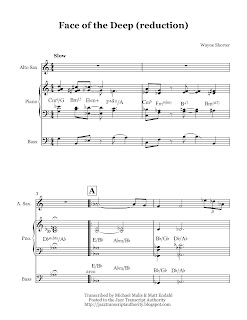
Wayne Shorter - Face of the Deep

Wayne Shorter - Face of the Deep


This song is transcribed from Shorter's fourth Blue Note LP, The All Seeing Eye. Recorded in one day (October 15th, 1965), the record featured his most ambitious composing and arranging to date. Shorter's record-buying audience would have gone straight to this from 1965's Speak No Evil (recorded in December 1964); a huge musical leap, even considering the "missing links": The Soothsayer and Etcetera. I call these "missing links" because although these were recorded in March and June 1965 (respectively), they apparently weren't released until 1979 or 1980.

The material on The All Seeing Eye was written for septet. The group featured Shorter, trumpeter Freddie Hubbard, trombonist Grachan Moncur III, alto saxophonist/flautist James Spaulding, and a rhythm section of pianist Herbie Hancock, bassist Ron Carter and drummer Joe Chambers. (Wayne's brother Alan Shorter replaces Hubbard on the final selection, "Mephistopheles", a tune which was also recorded on the Marion Brown date which the JTA previously featured.)

Therefore, this transcription should be considered a "piano reduction" of whatever the actual score may have looked like.

This transcription is a collaborative effort between myself and Michael Malis, a pianist, composer and teacher living in Detroit. Mike's a good friend of mine -- we were both students of Geri Allen at the University of Michigan. You can learn more about him by checking out his website. Thanks for the collaboration, Mike! (For the record, Mike did the initial transcription. I made some edits, which Mike agreed with.)

Tuesday, April 2, 2013

Lennie Tristano, Wally Cirillo & Claude Thornhill

Hey everyone

Today the JTA just hit a milestone: 10,000 hits! That's pretty cool, considering I've done practically nothing to promote this page. I'm happy that so many people are finding it useful and interesting.

Here are a couple new charts to celebrate: two from the Tristano camp and one from Claude Thornhill's book.

Also, don't forget: The Jazz Transcript Authority is based on an open-source model, which means you can feel free to contribute your own transcriptions of tunes. Just email them to jazztranscriptauthority@gmail.com. You can also feel free to point out corrections that you feel should be made to the transcriptions which I've posted, kind of like a peer-review site. The goal is to come up with the most accurate transcription possible, and that's easier when multiple sets of ears comb through these tunes. Please post comments with your suggestions if you hear something differently than me.

Billy Bauer - Marionette


(Update Sept. 2015: I just learned that this tune was written by guitarist Billy Bauer, not by Tristano. I apologize for the error.)

Tristano and his students/bandmates wrote so many good tunes that are hardly ever played today. Yet Tristano was, even in his day, regarded as a major figure in the modern jazz movement (Max Roach called Tristano's group the "Downtown School", while the group around Charlie Parker and Dizzy Gillespie was the "Uptown School") I think it's because few people ever take the time to transcribe them, and whatever transcriptions exist circulate very slowly, if at all. Even the tunes included in the 2nd Real Book Vol. II ("Lennie's Pennies", "April", etc.) have failed to become standards. In any case, here's one of his more well-known sides, taken from his influential May 1949 session.

Wally Cirillo - Transeason


One of the many unique contrafacts to come out of the Tristano school. This one is based on "All The Things You Are", a tune which Charles Mingus was particularly fond of manipulating in various ways. I don't know much about Wally Cirillo, but I do know he was a student of Tristano's. The sole recording of this piece is from January 1955, with Teo Macero playing tenor saxophone, Mingus playing bass, and Kenny Clarke playing drums. Oddly enough, although the melody of the tune is in Bb, the solo section modulates back to Ab, the standard instrumental key of "All The Things You Are".

Claude Thornhill - Snowfall


While technically it's spring, we're still getting through the last of our cold weather here in Michigan and I fully expect one more massive blizzard before springtime bliss. Just play this tune, it'll get you through the remaining cold days. (And don't transpose it either! C'mon, shed your altered dominants and have some fun.)

Monday, December 17, 2012

Two Tunes by Don Ellis

Hello everyone!

Dec. 17th 2012 marks the 34th anniversary of the death of the trumpeter Don Ellis. A 1956 graduate of Boston University's music composition department, he began his career playing trumpet in the Glenn Miller (Ray McKinley, cond.), Charlie Barnett and Maynard Ferguson bands. In the late 50's he recorded with Charles Mingus and in the early 1960's joined George Russell's influential sextet. It was also at this time that Ellis began recording as a bandleader, releasing three albums between 1960 and 1962.


His first, called "How Time Passes", borrows its name from the title of an essay by Karlheinz Stockhausen. The album was recorded in early October 1960 and featured a top-tier rhythm section of pianist Jaki Byard (who also doubles on alto sax), bassist Ron Carter and drummer Charlie Persip. Here are two tunes from this album:

Don Ellis - Sallie


A very lyrical melody, which could easily have words written to it. Note the casual way in which the dissonant F and D are used in the final B major chord. The influence of George Russell is palpable throughout this album, and especially in this bar.

My apologies for the switching between the keys of B and Cb. I try to let the melody lead the way when I transcribe, but if I hold to that exclusively, sometimes the melody demands a double-sharp chord symbol or something outlandish like that. I also find that mid-tune key changes can be distracting. I have tried to make the tune as readable and intuitive as possible. If someone has suggestions to make this clearer, I'm all ears.

Don Ellis - A Simplex One

 A tune which betrays a heavy Thelonious Monk influence. The progression near the end borrows from the harmonic progression of John Coltrane's "Giant Steps", which had only been known for about two years when "A Simplex One" was recorded. The two melodies may be played separately or simultaneously. The second melody may be an experiment with a 12-tone row idea.

Ellis' later work is much more well-known than these early records. In 1965 he formed the Don Ellis Orchestra, which stunned the audience at the 1966 Monterey Jazz Festival. By the late 60's the band had garnered a following among younger audiences, playing at many colleges and making a famous appearance at the Fillmore West alongside the Quicksilver Messenger Service. Ellis had also become involved in recording soundtracks, contributing to the soundtrack of Roman Polanski's "Rosemary's Baby". In 1972 his Orchestra recorded the soundtrack to the hit film "The French Connection", and continued to perform widely. In 1975, Ellis suffered from a heart attack which set him back quite considerably, although he was performing again by 1976. After continuing to have heart problems, Ellis stopped playing drums with his Orchestra, and eventually stopped performing altogether. He suffered a fatal heart attack on Dec. 17th, 1978.


Don Ellis 1934-1978

Saturday, June 9, 2012

Faruq Z. Bey

Faruq Z. Bey passed away on June 1st, 2012. I'm reposting this in his honor, and I'm working on some other transcriptions which I will post in the coming weeks.

Faruq Z. Bey - After Death
Originally posted Oct. 20th, 2009

A very influential figure in the history of jazz in Detroit, Bey was the involved with the Tribe collective in the 1970's. He led Griot Galaxy throughout the 1980's, a group which received fairly wide acclaim. The band sounded like a meeting of mid-70's Miles Davis and Sun Ra: brief ostinato-driven compositions giving way to intense modal/free improvisations. This particular piece was an important part of Bey's repertoire, both with Griot Galaxy and later with the Northwoods Improvisers.


The song appears on:

Griot Galaxy - "Opus Krampus" [CD Reissue]
Northwoods Improvisers w/ Faruq Z. Bey - "19 Moons"
Northwoods Improvisers w/ Faruq Z. Bey - "Infa'a"

Wednesday, April 18, 2012

Marion Brown / Ornette Coleman

Hey everyone -- It's been a while. Grad school is no walk in the park. But fortunately I've been keeping up with my tune transcribing, for various shows and groups. Here are a couple new ones:

Marion Brown - "Capricorn Moon"

A nice little tune, used as a vehicle for extended modal/free solos (the album version is more than 20 minutes long). This is the opening track on The Marion Brown Quartet (1966), featuring trumpeter Alan Shorter, drummer Rashied Ali, and bassists Reggie Johnson and Ronnie Boykins (from Sun Ra's band). Bennie Maupin also plays on the album, but is not on this track.

A few towering figures often define the New York jazz avant-garde of the 1960's: John Coltrane, Albert Ayler, Ornette Coleman, Cecil Taylor, Pharaoh Sanders... we often forget about figures like John Tchicai, Don Pullen, Alan Silva, Bill Dixon and Marion Brown, who were engaged with similar lines of inquiry: new ways of approaching improvisation, and new ways of blending it with composition. ESP-Disk' is an indispensable source for documentation of this very important musical scene.

Ornette Coleman - "Street Woman" 


Recorded in the early 70's, released on Science Fiction (1972). This album is a hodge-podge of elements tossed together, and slow-cooked to perfection. We hear many of Ornette's frequent collaborators like Charlie Haden, Ed Blackwell, Billy Higgins, Don Cherry and Dewey Redman, as well as a few fairly uncommon collaborators. For example, trumpeter Bobby Bradford, and New York Philharmonic trumpeters Gerard Schwarz (1973-1978) and Carmine Fornarotto (1962-1994). Additionally, two tracks feature the remarkable singer Asha Puthli, in some of her earliest recordings (she can also be heard on Peter Ivers' Take It Out On Me, and she has numerous excellent solo albums). Poet David Henderson can be heard on the title track. The album's production team is to credit as well, for they help to create the strange aural space that much of the album possesses. Engineers Stan Tonkel, Russ Payne, and producer James Jordan: props. James Jordan, also produced Coleman's Skies of America, as well as his most recent release Sound Grammar (check out this blog's very first post for a transcription of "Jordan" from this album)

Also, I haven't forgotten about "Splashdown"! In fact, it's almost done. I just need to figure out the weird keyboard/bass interlude... In the next post, I'll share a couple transcriptions of tunes by Giuseppi Logan, to me one of the oddest figures from the ESP-Disk' scene.

Tuesday, November 1, 2011

More Ornette!

Happy November! Time for some more charts. These two tunes come from the 20th anniversary edition of Ornette Coleman's collaborative album with Pat Metheny Song X:

Ornette Coleman - Police People

Ornette Coleman - All Of Us