Monday, September 29, 2014

Warne Marsh, John Lewis

I've posted a few tunes from Tristano and his students in the past. Here's one that was written by Warne Marsh, Dixie's Dilemma. A contrafact on Jerome Kern's classic All The Things You Are, the tune's title has a colorful and vulgar story behind it that I won't summarize here. As with most of the Tristano school's compositions, this one is beautiful, clever, and difficult.


It's all the more remarkable considering that both Marsh and fellow saxophonist Ted Brown play this composition on tenor saxophone, a real workout of the horn's altissimo range.


I've also decided to take a crack at Milestones, a composition written by either Miles Davis or John Lewis, depending on which source you believe. While original credit for the composition went to Charlie Parker, almost every contemporary source disagrees with this. But whether the actual author was Miles Davis or John Lewis remains a matter of some dispute, even among prominent writers. Feather (1949, p. 18), Yanow (2000, p. 76), Koch (1988, p. 103) and Tingen (2001, p. 29) credit Davis, while Giddins (1998, p. 340), Priestly (2005, p. 59), and Szwed (2002, p. 60) credit Lewis. Giddins includes elaborate anecdotal information about the recording session, and asserts that the tune was written "as a gift" from Lewis to Davis. So until I hear a compelling contradiction to this story, I'll go with Lewis as the author of Milestones.


As always, your input is welcome. Post a comment!

Sunday, August 31, 2014

Two Compositions by Dennis Sandole

(Hey everyone. On August 12th, we hit 20,000 views. Thanks for helping this blog grow!)


Dennis Sandole is a prodigiously influential figure in jazz history who is generally unknown; many jazz encyclopedias don't have entries for him.  Best known as having been a teacher of John Coltrane (beginning in 1946), Sandole was a skilled guitarist, innovative composer and deep musical thinker.
(Listen while you read)


Dennis Sandole

I don't have any new information to add to the life story of Dennis Sandole, so I'll just recap what you can find with a quick Google search. Sandole was born in Philadelphia in 1913. Self-taught as a guitarist, he worked as a staff musician at MGM Studios in Hollywood for several years beginning in the 1930's. In the 1940's he returned to Philadelphia where he taught at the Granoff School of Music, founded by Isadore Granoff. During that period he appeared on recordings by the Tommy Dorsey and Charlie Barnet bands. He also performed with the Ray McKinley and Boyd Raeburn bands. (For more info, see my 2018 post.)

The Brothers Sandole, Modern Music from Philadelphia
Fantasy 3-209
In 1955, Dennis and his brother Adolph gathered an ensemble of top New York and Philadelphia musicians to record their compositions. Featured on the recording are Art Farmer, George Barrow, Teo Macero, Milt Hinton, and others. The recordings were released by Fantasy records, a major jazz label who also had released recordings of Dave Brubeck, Cal Tjader, and Vince Guaraldi. The Sandole recordings came out as a 10" record called "Modern Music from Philadelphia" (which was reissued on CD by Fantasy Records in 2001 as "The Sandole Brothers & Guests").

Sandole's only other recording as a leader looks to be a record called "Compositions and Arrangements for Guitar" (1958), also released by Fantasy, but this item appears to be fantastically obscure. 
All Music Guide makes mention of it, and Mike Callahan lists the album in an exhaustive Fantasy Album Discography. Callahan also helpfully notes that the album was "Originally issued in monaural only", suggesting that the album had actually been recorded and released. WorldCat doesn't list it, and the Library of Congress doesn't have it. I haven't checked Lord's Discography yet. (Update: I checked Lord's discography. It's not there.)

In any case, after the Fantasy releases, Sandole continued to be active as a teacher, but I cannot find any recordings on which he appears, either as a leader or as a sideman. In fact, no other recordings of Sandole were made commercially available until 1999, when Cadence released a compilation of Sandole's various projects, including some extremely rare quartet recordings from 1958 with pianist Al Del Governatore, bassist Wendell Marshall, and drummer Frank Young. The fidelity is poor, but the compositions are stunning, and I think earn Sandole a spot alongside Charlie Parker, George Russell, Thelonious Monk, and Lennie Tristano as a major figure in post-war jazz composition.


Sandole is featured as a soloist in his composition "Dark Bayou", recorded by Charlie Barnet's Orchestra in 1946.
 (His solo begins at 1:30.) He co-wrote the breezy "High On An Open Mike" with fellow Philadelphian Charlie Ventura, who recorded the tune with his orchestra in 1949 and performed it live. And in the 1960's, his compositions were featured on albums by Art Farmer and James MoodySandole's students included John Coltrane, Pat Martino, Jim Hall, James Moody, Benny Golson, Michael Brecker, Stanley Clarke, and Matthew Shipp. He wrote at least two books, one of which, Guitar Lore, has been published. Sandole died in September 2000.

Here are two of Sandole's compositions:


Wayward Plaint was recorded by James Moody in 1964, and Michael Grossman recorded it in 1997. I'm not aware of any other recordings of the tune.


To my knowledge, the only recording of Monody is on the above-mentioned Dennis Sandole Project CD, put out by Cadence in 1999. It's beautiful and strange, as you'll find out if you play it.

Additional reading:

Matthew Shipp's recollections about his studies with Sandole.

- A powerpoint presentation called "The Unique Jazz Pedagogy of Dennis Sandole" by Thomas Scott McGill, which includes scanned images of Sandole's lesson assignments.

- A blog post by a trumpeter Bart Miltenberger who studied with Sandole.

Sunday, August 24, 2014

Rhodes part on "It's About That Time"

Ahoy hoy! Earlier this summer, I received the following comment:


A close listen to the recording suggests two things: 1) there is some sort of core voice leading going on that is more or less the same throughout, and 2) Herbie Hancock and Chick Corea are each adding their own alterations to these core voices, and change these each time. So, without digging into the rich alterations used by Corea and Hancock, I think this is a close approximation to what they were working with:


(To download MIDI file click here.)

To hear the passage I listened to for this, begin at 4:57 of this video.

I'm not especially happy with the 4th chord, but I think the others are pretty close. I'm very interested to hear what other people think. Post a comment!

Tuesday, July 29, 2014

George Russell - Part Two

I'm not keen on explaining myself to "The Internet", but I feel that a 14-month delay deserves a bit of background, especially when it bears directly on the subject at hand.

When I planned on doing a two-part feature on George Russell's compositions, I had already transcribed both "Lydiot" and "Ezz-Thetic". I had consulted various recordings of the latter, eventually settling on what I took to be the "definitive" version: the version on Russell's Jazz Workshop (rec'd in 1956). I also referred to his recording from a few years later entitled Ezz-Thetics (1961).


Russell's Jazz Workshop (1956)

But as I continued my research, I realized that there were many recordings of "Ezz-Thetic", and almost all of them were different in some key ways. I'll return to this point as we go along. Let's first get to the tune.

In a post from April 2013, I mentioned that Max Roach characterized modern jazz in New York as having an "uptown" and "downtown" school. The uptown school was defined by the crowd that included Charlie Parker and Dizzy Gillespie, and the downtown school was defined by Lennie Tristano and his various students (especially Lee Konitz and Warne Marsh). Of course, these schools were not homogenous and isolated; collaborations and sharing of ideas was commonplace. But they had their definite identities that can be heard in the music. (think about the difference between Miles Davis' "Donna Lee" and Lennie Tristano's "Wow"!)

George Russell's "Ezz-Thetic" was written in 1948, but it has a strikingly idiosyncratic sound, even compared to both the uptown and downtown schools. Tristano, Monk, and others experimented with dissonance, but not like this. Russell's melody stretches the harmonic structure of Cole Porter's "Love For Sale" to its limits, nearly tearing it to pieces:


(A lot of information that was available to the band on the recording date that is missing here. But this lead sheet should be enough to get you started.)

The composition is easily Russell's most well-known, having been recorded in 1951 for Prestige by a group led by Lee Konitz which included Miles Davis. (By the way, this recording is a great example of how the uptown and downtown schools worked together: Konitz, pianist Sal Mosca, bassist Arnold Fishkin and guitarist Billy Bauer were all Tristano-ites, and were working with Davis and Max Roach.) Russell himself recorded "Ezz-Thetic" at least three times, and versions also exist by Grant Green and Max Roach. In addition, the New York Contemporary Five (led by Archie Shepp) used the introductory statement of "Ezz-Thetic" as a sign-off to end their shows. Russell even wrote an arrangement for Charlie Parker and strings, but this was never recorded.

Russell's Ezz-Thetics (1961)


Transcribing "Ezz-Thetic" was challenging, not just because of the angularity of the melody, but because in each recording, there are slight differences made to the melody's notes and rhythms. For example, compare bars 5-6 of the version on Russell's Jazz Workshop and Ezz-Thetics recordings:

Ex. 1

with Grant Green's recording (Solid, rec'd 1964):


Ex. 2

Green's recording, which features saxophonists James Spauling and Joe Henderson, is different from Russell's in a number of other ways, and deserves a lead sheet of its own. As a second example, compare the last two bars of the bridge on three versions. First, the version from Russell's Jazz Workshop and Ezz-Thetics:


Ex. 3

Note the ascending 1-2-1 (semitone - whole tone - semitone) relationship in the second bar of the example, resulting in a downward major-3rd needed to return to the tonic. Next, the same two bars in Green's version:

Ex. 4


In this case, an ascending 1-2-2 (semi-whole-whole tone) relationship is heard. But this is jarringly different in Lee Konitz's version (The New Sounds, Prestige, rec'd 1951), in which he swaps the Eb and E(nat):

Ex. 5

On the Prestige recording, the head out consists just of one playing of the tune's A section, so we don't get to hear Konitz play this version of the bridge again. But if we fast-forward by 35 years, we can find another version recorded by Konitz in which he plays the same figure. (Ideal Scene, Soul Note 1986). If we wish to pursue the matter further, we can look to Konitz's duo record with pianist Harold Danko entitled Wild as Springtime. On both the alternate and the master take, Konitz (in unison with Danko) plays the figure in Ex. 5.

Such examples present us with some philosophical puzzles that are beyond the scope of this blog post, but which are partly responsible for the 14-month delay in its publication! One thing is clear: It's disingenuous to say that Konitz, Green, Henderson, etc. were all playing the tune "wrongly". (Especially when you consider that Russell himself wrote the bridge as Ex. 5 for his New York Band... see Live in an American Time Spiral, rec'd 1982) So the whole debate just seems a little dumb: try your best to respectfully represent the tune, whether you're transcribing it or whether you're playing it.


Lee Konitz, The New Sounds

So that's my excuse for the delay on part 2. Oh yeah, I also moved to Nashville, got a dog, and got married.

[In researching this blog post, I came upon the doctoral dissertation of Peter Kenagy, which provided very useful details about Russell's Jazz Workshop album. Thanks for your work, Peter.]

Friday, May 31, 2013

George Russell - Part One

George Russell (1925-2009) is one of the most important figures in 20th century music. As a theorist, his Lydian Chromatic Concept of Tonal Organization introduced the concept of chordmode, which synthesized horizontal (linear) and vertical (chordal) pitch organization into a single principle. A similar principle had already been known to Western theory since the Baroque period, but Russell articulated it in terms of contemporary jazz practice, at a time in American history when Baroque music theory would have been inaccessible (for obvious reasons) to many practicing jazz musicians.

The LCC was first published in 1953, but only a handful of copies were made. It saw a second, more prolific printing in 1959, at a time when more and more colleges were hiring jazz musicians as faculty members. Russell's chordmode idea influenced David Baker, whose student, Jamey Aebersold, would later build a publishing franchise out of the idea.

As a result, Russell's ideas became and remain the cornerstones of contemporary jazz education, although this contribution of his is seldom recognized, and few (if any) of his compositions have entered the "standards" repertoire.

Russell was also an inspired composer and arranger. In the late 1940's he wrote large ensemble works for Benny Carter, Dizzy Gillespie, Ella Fitzgerald, Charlie Parker, and Artie Shaw. Throughout his life he wrote and directed many major works, and led various small groups in America and Europe. In 1969 he joined the faculty at Boston's New England Conservatory of Music, a position he held until 2004. He received three Guggenheim fellowships (1969, 1972 and 1980), six NEA fellowships (1969, 1976, 1979, 1980, 1981 and 1985) and a MacArthur fellowship (1989).

As a pianist, Russell had a probing, rhythmic style, highly inspired by Duke Ellington and Thelonious Monk, and somewhat reminiscent of the early Cecil Taylor.

George Russell - Lydiot


To my knowledge, the first recording of this tune was on Russell's 1960 large ensemble recording Jazz in the Space Age. It was recorded again the following year on his sextet recording Ezz-thetics. The two versions are slightly different; this transcription is from the latter source. It's a pretty typical Russell tune, a sort of Schoenbergian post-bop line.

I'm not too sure about the chords. I listened carefully to Steve Swallow's basslines and Russell's chords, and this is what I came up with. As always, feedback is welcome.

I'm working on a transcription of Russell's composition "Ezz-thetic", which I'll post next time. Stay tuned!

Wednesday, May 15, 2013

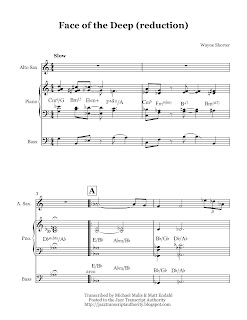
Wayne Shorter - Face of the Deep

Wayne Shorter - Face of the Deep


This song is transcribed from Shorter's fourth Blue Note LP, The All Seeing Eye. Recorded in one day (October 15th, 1965), the record featured his most ambitious composing and arranging to date. Shorter's record-buying audience would have gone straight to this from 1965's Speak No Evil (recorded in December 1964); a huge musical leap, even considering the "missing links": The Soothsayer and Etcetera. I call these "missing links" because although these were recorded in March and June 1965 (respectively), they apparently weren't released until 1979 or 1980.

The material on The All Seeing Eye was written for septet. The group featured Shorter, trumpeter Freddie Hubbard, trombonist Grachan Moncur III, alto saxophonist/flautist James Spaulding, and a rhythm section of pianist Herbie Hancock, bassist Ron Carter and drummer Joe Chambers. (Wayne's brother Alan Shorter replaces Hubbard on the final selection, "Mephistopheles", a tune which was also recorded on the Marion Brown date which the JTA previously featured.)

Therefore, this transcription should be considered a "piano reduction" of whatever the actual score may have looked like.

This transcription is a collaborative effort between myself and Michael Malis, a pianist, composer and teacher living in Detroit. Mike's a good friend of mine -- we were both students of Geri Allen at the University of Michigan. You can learn more about him by checking out his website. Thanks for the collaboration, Mike! (For the record, Mike did the initial transcription. I made some edits, which Mike agreed with.)

Tuesday, April 2, 2013

Lennie Tristano, Wally Cirillo & Claude Thornhill

Hey everyone

Today the JTA just hit a milestone: 10,000 hits! That's pretty cool, considering I've done practically nothing to promote this page. I'm happy that so many people are finding it useful and interesting.

Here are a couple new charts to celebrate: two from the Tristano camp and one from Claude Thornhill's book.

Also, don't forget: The Jazz Transcript Authority is based on an open-source model, which means you can feel free to contribute your own transcriptions of tunes. Just email them to jazztranscriptauthority@gmail.com. You can also feel free to point out corrections that you feel should be made to the transcriptions which I've posted, kind of like a peer-review site. The goal is to come up with the most accurate transcription possible, and that's easier when multiple sets of ears comb through these tunes. Please post comments with your suggestions if you hear something differently than me.

Billy Bauer - Marionette


(Update Sept. 2015: I just learned that this tune was written by guitarist Billy Bauer, not by Tristano. I apologize for the error.)

Tristano and his students/bandmates wrote so many good tunes that are hardly ever played today. Yet Tristano was, even in his day, regarded as a major figure in the modern jazz movement (Max Roach called Tristano's group the "Downtown School", while the group around Charlie Parker and Dizzy Gillespie was the "Uptown School") I think it's because few people ever take the time to transcribe them, and whatever transcriptions exist circulate very slowly, if at all. Even the tunes included in the 2nd Real Book Vol. II ("Lennie's Pennies", "April", etc.) have failed to become standards. In any case, here's one of his more well-known sides, taken from his influential May 1949 session.

Wally Cirillo - Transeason


One of the many unique contrafacts to come out of the Tristano school. This one is based on "All The Things You Are", a tune which Charles Mingus was particularly fond of manipulating in various ways. I don't know much about Wally Cirillo, but I do know he was a student of Tristano's. The sole recording of this piece is from January 1955, with Teo Macero playing tenor saxophone, Mingus playing bass, and Kenny Clarke playing drums. Oddly enough, although the melody of the tune is in Bb, the solo section modulates back to Ab, the standard instrumental key of "All The Things You Are".

Claude Thornhill - Snowfall


While technically it's spring, we're still getting through the last of our cold weather here in Michigan and I fully expect one more massive blizzard before springtime bliss. Just play this tune, it'll get you through the remaining cold days. (And don't transpose it either! C'mon, shed your altered dominants and have some fun.)